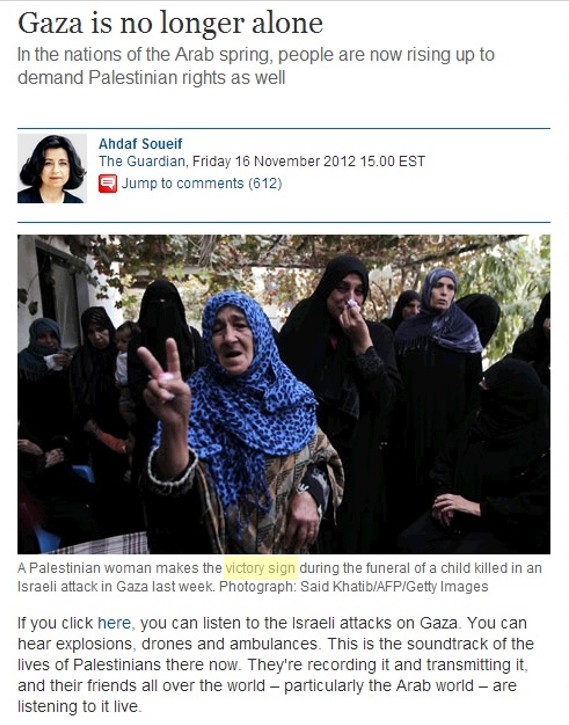
 My compassion turned to shock after reading the caption of a photo of mourners at the funeral of a child killed in an Israeli attack in Gaza earlier this month. The caption indicated the photo’s main subject, an elderly woman wearing a bright blue leopard print head scarf, was making the victory sign as women grieved in the background.
When I first saw the photo I assumed she was making the peace sign, perhaps to signal her frustration with the fighting between Hamas and Israel. Mothers and grandmothers yearning for peace is a totally different interpretation than somebody perceiving the death of a child as a victory of some kind.
Then I thought of all the photos I’ve seen in recent years, largely via Twitter, of Tunisians, Egyptians, and Libyans making the V sign. In the context of their Revolution 2.0s, I had definitely interpreted their hand gestures as a hopeful victory sign, not something to do with stopping war. But then I remembered recently seeing a photo of a Tunisian woman making the V sign at a rally protesting a woman being charged with indecency after being raped by policemen. Neither peace nor victory seemed to make sense in that context.
The more I thought about it, I wondered if Middle Eastern usage of the V sign just does not translate properly through a Western lens. Does the elderly woman in the photo even speak English and know the word “victory”? Is she familiar enough with the Latin alphabet to know what the letter “V” is? If she does not know the word “victory” and has no idea what the letter “V” is, could she possibly mean something different altogether, something closer to unity or solidarity? Without a way of contacting the photographer or the woman in the photo, I am just left wondering whether the caption, written through a Western lens, was spot on or only superficially accurate.
Now to my point.
Much media attention has been given to Israel and Hamas’s use of social media during the recent conflict. Both sides were appealing to world opinion to make the case that the other side does not respect human rights. I do not think it is a stretch to state propaganda was used, and deciphering the truth in an atmosphere clouded with propaganda (and the painful emotions of war) is hard… especially when you have a limited understanding of the cultures being depicted.
Thanks to Andy Carvin (see bottom of story linked), my tweet stream was filled with updates from real people at the frontlines of the recent conflict. While I found viewing these tweets a little depressing, I find hope in social media’s growing ability to connect us with civilians who do not have any agenda but do have on-the-ground situational awareness. When you see a tweet with a photo of an explosion near somebody’s home you can quickly read the person’s tweet stream to discern context and credibility (boosted if retweeted by Andy Carvin). Likewise, when you see a tweet with a photo of people making the V sign, you have a more clear idea whether they mean peace, victory, unity/solidarity, or something else entirely.
Most importantly, you can ask the source directly if you are unsure.
In other words, social media’s self-cleaning oven “auto-correct” properties gives ordinary citizens the power to further understanding between people and break down the good-versus-evil stereotypes that propaganda can perpetuate to justify war.
My fingers are crossed the path to elusive Middle East peace lies in this direction.
 About Monica
 Follow me on Twitter
 Subscribe via RSS feed
Thanks for another great post Monica. One thing I can add is that when I saw all the tweets retweeted by Andy Carvin, I got the feeling that he and us are all learning as we go along. What I mean is that many of his retweets were government propaganda, one person’s very subjective opinion or graphic pictures/video. Thats 80, 250 (and counting) followers of Carvin not only seeing what is happening on the ground and getting the emotional pulse of the conflict but also being fed propaganda and “if it bleeds it reads/leads” type media that does not help either side. Information is power, inaccurate information also has power… we need to be careful and sober minded with it.
Thanks for reading and commenting on my post, Monica. I agree totally that information is power, inaccurate or not. Interestingly, Andy just responded to a tweet I sent him asking him whether the V sign means peace, victory, or unity in Gaza. He responded “victory” (see https://twitter.com/acarvin/status/272911066453917697). I am not sure if that settles it or, to cite your point, if we are all learning as we go. Either way, his response does illustrate social media’s power to connect and build bridges to understanding. By the way, do you know anyone in your peace-making circles who can speak with authority on the V sign question?
@CyberlandGal Andy followed up with a tweet indicating his sources have indicated people in Middle East mean victory when they flash V sign, but it can have different meanings in different contexts. See https://twitter.com/acarvin/status/273060577042132992
Monica, as far as I know – the V sign used by Palestinians stands for ‘Victory’. This, I believe, was popularized by Yasser Arafat during the first Palestinian Intifada in the 1980s. Muslims in the Arab world see martyrdom as part of god’s will and in islamic laws – the martyrs have a guaranteed spot in heaven.
@abdallahalhakim Thanks for taking the time to clarify, Abdallah. I really appreciate it! What do you think the Tunisian woman at the protest rally shown here https://encrypted-tbn1.gstatic.com/images?q=tbn:ANd9GcROah4WS6rhAti54SeNgrXvK9dcTHL4Pt3JGrWM8hGwgfXsHRO- and described here http://www.guardian.co.uk/world/2012/oct/03/tunisians-protest-charges-woman-police means? Nobody died, and it’s not clear to me where the victory is… the number of people at the rally? Again, I appreciate your taking the time to comment.
@CyberlandGal I could not open the image link but I did read the guardian article. If a V sign was used there then I would guess it is to do with peace rather than victory. The conditions between Tunisia and the Palestinian territories are quite different and despite the common culture ties – there could be a different common use of the ‘V’ sign.
@abdallahalhakim Thanks again for taking the time to comment, Abdallah! Sorry about the link. Here it is again: http://www.demotix.com/photo/1494268/demonstration-trial-tunisian-girl-raped-policemen (also in post above if you click on the text reading “photo of a Tunisian woman making the V sign” in the third paragraph). I have noticed lots of V signs recently in Syria photos recently too per http://www.demotix.com/photo/1467400/rally-solidarity-suffering-children-and-mothers-syria … Not exactly sure what they mean either. You make a good point that cultures in the Middle East are very different, and I do think people in the United States can lump everyone together… except when it comes to Europe (everyone intuitively knows there are cultural differences between say Spain, Ireland, or Switzerland). Thanks again for taking the time to comment.
I enjoy looking through an article that will make people think. Also, thank you for allowing me to comment!
Thanks for your kind words, Felisha!
I just discovered a link above is no longer working to a Wikipedia article talking about the Belgian use of the V sign during World War II. The link appears in the following text: “could she possibly mean something different altogether, something closer to unity or solidarity?” I recall the Wikipedia text, which has since been deleted, talked about Belgians using the sign as a symbol for solidarity. The new text talks about the Belgians using it to symbolize vrijheid, which means freedom in Dutch. Victory? Peace? Unity? Freedom? All very different meanings depending upon the context.